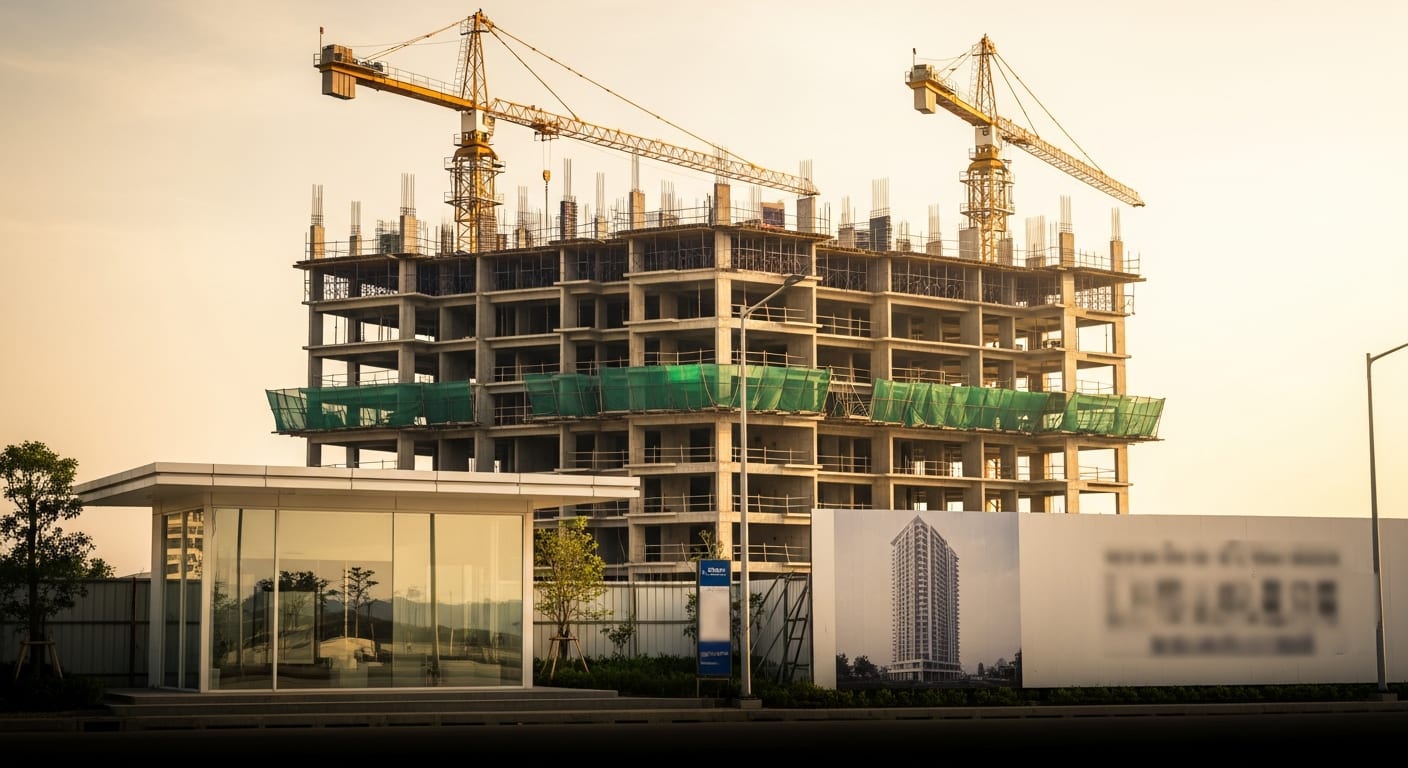
Off-plan accounts for a meaningful share of Pattaya's current condo stock. Buying before completion can secure better pricing, foreign quota, and floor selection. It also concentrates risk in a window where the building does not yet exist, the developer holds your money, and Thai law gives you fewer automatic protections than buyers expect from European or Australian markets. This Guide is the checklist we walk our own clients through before any deposit moves.
The legal spine
Three statutory anchors govern off-plan condo sales in Thailand.
Section 6 ter of the Condominium Act (added by the 2008 amendment) requires developers selling condominium units before completion to register the project with the Office of Consumer Protection Board (OCPB). The licence confirms the developer has met financial-capability conditions and that the sale documents conform to the regulated form. A developer selling off-plan without OCPB compliance is selling outside the framework that protects you.
Section 19 bis sets the foreign-ownership ceiling at 49% of total saleable area in any condominium building. In off-plan, that quota is allocated on a first-committed basis. Latecomers get pushed to leasehold of the same unit. If you are a foreign buyer, you reserve the freehold quota in writing at the contract stage; verbal assurance is not allocation.
Section 30 of the Condominium Act addresses the developer's obligation to provide a financial guarantee covering construction obligations, intended to protect buyers if the project is abandoned mid-build. The mechanism exists; the practical reach varies. Ask the developer to show you the guarantee document and the issuing bank.
Layered above those: the Environmental Impact Assessment (EIA) requirement under the Enhancement and Conservation of National Environmental Quality Act. EIA is mandatory for residential projects of 80 units or more, or 4,000 sqm of built area or more. EIA must be approved before construction starts. ONEP (Office of Natural Resources and Environmental Policy and Planning) is the issuing authority. Some Pattaya projects historically pre-sold before EIA approval; the practice is being closed off, but it still happens.
What changed in 2025
On 31 January 2025 the OCPB's controlled-reservation-contract rule took effect. It standardises the Thai-language reservation form, bans clauses that confiscate deposits when the buyer is not in default, and gives the buyer explicit termination rights if the developer fails to obtain EIA approval, fails to obtain the construction permit, fails to sign the full sale contract within the agreed window, or alters the project specifications without consent. Penalties for non-compliant contracts run to THB 200,000 and potential imprisonment.
This is the single biggest upgrade in Thai off-plan buyer protection in the last decade. Before signing any reservation, confirm the document follows the OCPB standard form. If it does not, that is the first red flag.
Deposit and milestone structure
Typical Pattaya off-plan structure: a small reservation deposit (THB 100,000 to 200,000), then 25 to 35% on contract, then milestone payments tied to construction stages: foundation, structure, façade, interior fit-out, hand-over. Total payments usually complete at transfer.
Thailand does not mandate escrow. Buyer funds typically go directly to the developer's bank account and are not legally required to be ring-fenced from operating funds. Commercial escrow services exist (licensed under the Escrow Act 2008) and are available for off-plan use. They are optional. A developer who refuses to use escrow on request is telling you something useful about how they manage risk.
The asymmetry to plan for: buyers typically forfeit the deposit if they walk; developers retain deposits during their own delays unless the contract says otherwise.
Due diligence checklist
Before deposit:
- EIA status. Approved before you pay. Verify with the project's EIA reference number against ONEP records.
- OCPB compliance. Reservation contract follows the post-31-January-2025 standard form, in Thai.
- Construction permit. Issued by the local authority (Pattaya City or the Tambon administration depending on location).
- Section 30 guarantee. Bank-issued construction guarantee in place. Ask to see the document.
- Foreign-quota allocation. Reserved in writing for foreign buyers wanting freehold.
- Developer track record. Prior completed projects, on-time delivery, after-sale management. DBD lookup at dbd.go.th gives you the company filings, shareholder structure, and any pending litigation.
- Financial structure. Holding-company layout, who actually owns the land, whether the project is debt-financed and on what terms.
- Force-majeure and grace-period clauses. Standard contracts give the developer 6 to 12 months grace beyond contractual completion. Beyond that, the buyer's right to terminate and reclaim deposit is contract-dependent and often subject to litigation.
- Escrow option. Ask. Evaluate the answer.
Patterns of failure
The textbook Pattaya case is the Waterfront Suites and Residence at Bali Hai Pier, a 53-storey tower whose construction was halted in 2014, whose developer faced bankruptcy and litigation, and which has stood incomplete for over a decade. The case became severe enough that arrest warrants were issued in 2023 over the original approval. It is the local cautionary reference for what happens when a project goes wrong.
The operational signals to watch on any active project: repeated milestone delays, change of main contractor mid-build, visible labour-force shrinkage on site, suspended or downgraded sales activity, unexplained changes in project specifications or unit count. Any one of these in isolation can have a benign explanation. Two or more together justify a hard conversation with the developer or your lawyer.
The frame
Off-plan in Pattaya is not categorically risky and not categorically safe. It is a contract market where the legal framework gives you specific protections (Section 6 ter, Section 30, Section 19 bis, EIA, the 2025 OCPB rule) provided you use them. The buyers who get burned are almost always the ones who paid before verifying. The buyers who do well are the ones who treated the reservation as a legal transaction, not an emotional one.